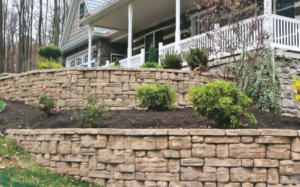
 Retaining walls look great and prevent soil erosion at the same time. Retaining walls are great for flowerbeds and gardens and provide some texture to your landscape design. There are basically 4 types of retaining walls and the following is an explanation of each type of retaining wall…
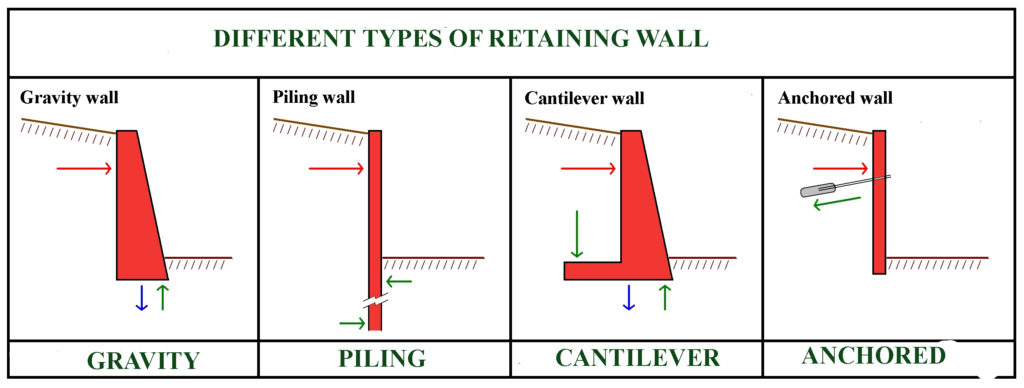
Gravity Retaining Wall
This is the most basic of all retaining walls because they use their weight and mass to hold back soil. Gravity retaining walls are made with bricks, pavers, unmortared stone, dry stack stone, and more. Trenches are laid and sometimes a concrete footer is made to hold the the wall in place, depending on how much earth needs to be held back by the wall.
Cantilevered Retaining Wall
This is a reinforced retaining wall that uses steel bars though the concrete to give it more strength. A slab created and laid under the soil and the retaining wall is fixed to the slab. The soil holds the slab down and keeps the wall from falling forward. Many commercial retaining walls are built this way. These walls can also be built in a counter-fort or buttressed style to give them even more strength.
Sheet Piling Retaining Wall
When space is an issue and the soil is soft, a sheet pile retaining wall made of steel, wood, or vinyl is driven directly into the soil. Most sheet piling retaining walls are built with corrugated materials and they need to be driven at least 1/3 of the way into the ground to hold back the soil and larger sheet piling walls will need to be anchored.
Anchored Retaining Wall
Anchored retaining walls are anchored from the front of the wall to cables and strips that hold then in place. Later pressurized concrete is forced in to make them even more strong.
We Provide Retaining Wall Installation, Repair, and Maintenance Services
Retaining wall services extend beyond mere structural construction, encompassing considerations such as drainage, soil composition, and the integration of landscaping elements.
> Learn More
Davis Landscape can help you achieve the landscaping you dream about! We also help our clients with hardscapes such as retaining walls, patios, walkways, driveways, outdoor kitchens, fire pits, & more!
Contact Us (859-781-0677) for More Information!
—
 About Davis Landscaping
Davis Landscape Design & Installation has been providing landscaping services to customers in Northern Kentucky and Greater Cincinnati since 1965! We know that the landscape design process can be overwhelming, so we work with you tirelessly to better understand your vision. At Davis Landscape Design & Installation, we’re on your team and we know how to listen and deliver.